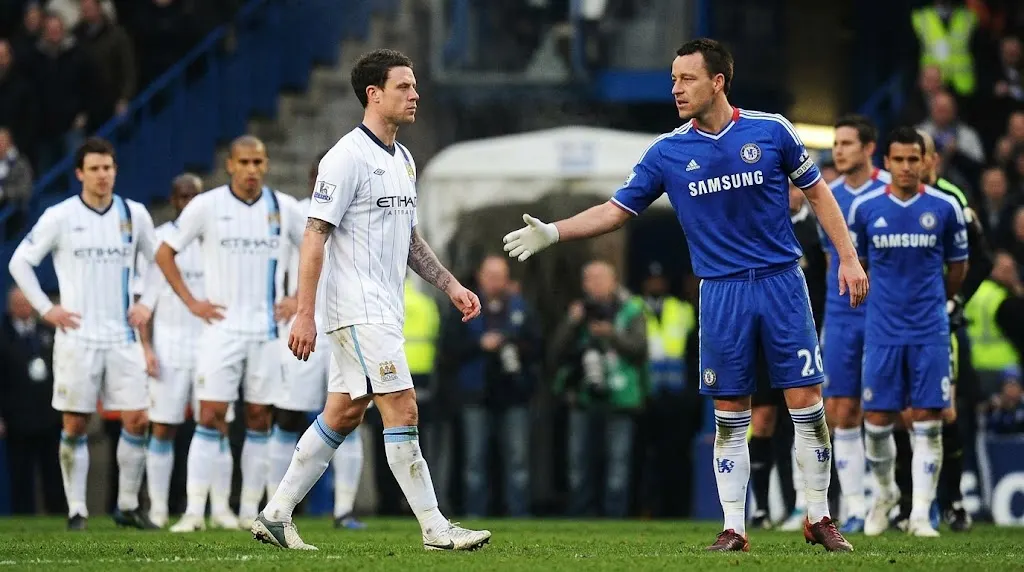
The tunnel inside Stamford Bridge felt completely frozen. It was February 27, 2010, and forty thousand fans were roaring in the stands. Television cameras zoomed straight into the tunnel, ignoring the tactics and the managers. Every single eye was searching for just two men: John Terry and Wayne Bridge.
Terry stepped out first, wearing Chelsea royal blue with the captain’s armband squeezed around his bicep. Behind him, dressed in Manchester City sky blue, walked Bridge. His jaw was set tight, and his eyes stared directly into the back of the player in front of him.
The two teams lined up on the grass for the standard pre-match Fair Play handshakes.
Terry stood in place, waiting as the Manchester City players walked past him. He put out his right hand, open and waiting, just like he had done hundreds of times before.
Bridge did not break stride.
He did not look at Terry’s face. He kept his left hand glued to his hip, pulled his right arm back, and let Terry’s palm hang in thin air. Without blinking, Bridge reached right past his former friend and gently shook the hand of the young mascot standing beside him.
A loud gasp rolled across the stadium, followed instantly by a storm of boos. In less than two seconds, without saying a single word, Bridge had delivered the most famous snub in football history.
To understand how heavy those two seconds were, you have to go back to when the two men were practically brothers.
Between 2003 and 2009, Bridge and Terry were rock-solid teammates at Chelsea. They won the Premier League title together, lifted domestic cups, and shared the pitch for the England national team. They were not just colleagues at work; they were close personal friends who lived in the same neighborhood in Surrey.
They barbecued together. Their families spent holidays together. When Bridge signed for Manchester City in 2009, the bond between the two defenders remained strong.
Then came January 2010.
British newspapers dropped a massive story across every front page in the country. Reports revealed that Terry, who was married, had carried out an affair with French model Vanessa Perroncel. Perroncel was Bridge’s ex-partner and the mother of his young son.
The news shocked the country and caused total chaos inside English football.
Terry was not just any player. He was the captain of England, the man chosen to lead the country into the 2010 World Cup in South Africa just four months later. Suddenly, the national team captain stood accused of breaking apart the family of his own international teammate.
England manager Fabio Capello acted swiftly. Capello flew into London, held a short twelve-minute meeting with Terry at Wembley Stadium, and stripped him of the captain’s armband on the spot.
Bridge remained completely silent through the storm. He did not sell interviews. He did not post angry rants. He simply put his head down, went to training in Manchester, and waited for the fixture list to catch up with him.
When the schedule brought Manchester City to Stamford Bridge that Saturday afternoon, the tension was unbearable.
Leading up to kickoff, officials debated whether to cancel the handshake ritual altogether to avoid a scene. The Premier League refused, insisting the Fair Play ceremony must go on as normal.
That decision forced the moment into reality. The cold snub set the tone for an afternoon of pure fury on the pitch.
Chelsea supporters turned on their former left-back, loudly booing Bridge every time his boot touched the ball. But if Chelsea thought Bridge would crumble under the noise, they were mistaken. His Manchester City teammates rallied around him like a wall of bodyguards.
Craig Bellamy and Carlos Tevez played like men possessed.
Every tackle was razor-sharp, and every loose ball turned into a battle. When City pushed forward, Chelsea looked rattled and disorganized.
Tevez struck twice, punishing Chelsea’s backline with ruthless finishing. Bellamy was unstoppable on the wing, slicing through the defense to score two goals of his own.
Manchester City ran riot, smashing Chelsea 4-2 on their own ground.
When Bellamy scored City’s fourth goal, he did not just celebrate. He turned toward the Chelsea bench and yelled with pure defiance. The entire Manchester City squad walked off the pitch with their arms wrapped around Bridge’s shoulders.
After the final whistle, Bellamy did not hold back in his television interview.
“I know what JT is like,” Bellamy told reporters. “Nothing surprises me. The most important thing was our team, and especially Wayne. We all love Wayne, and everyone in our dressing room was playing for him today.”
The match ended, but the personal heartbreak did not disappear with the three points.
The 2010 World Cup was only weeks away. Capello wanted Bridge in his 23-man squad as England’s primary backup at left-back behind Ashley Cole. Playing in a World Cup is the absolute peak of any professional footballer’s life.
Bridge made a painful choice. He walked away from it entirely.
He released a brief, dignified statement announcing his retirement from international duty. He explained that his presence in the squad would be “untenable and potentially divisive.”
Bridge refused to force his teammates to pick sides. He gave up his childhood dream of playing in South Africa because he could not bear to share a bus, a dining table, or a dressing room with Terry.
Without Bridge, England traveled to South Africa with an atmosphere poisoned by mistrust.
The squad looked miserable, divided, and exhausted. Terry had a poor tournament, Capello struggled to control player rebellions in the camp, and England crashed out in the Round of 16 after a crushing 4-1 loss to Germany.
Terry continued his glittering club career at Chelsea, lifting more trophies and Champions League glory. Yet, that empty right hand hanging in the cold February air became an image he could never run from.
Wayne Bridge never wrote a tell-all book about that winter. He never tried to turn the scandal into money or fame.
His answer was given on the Stamford Bridge pitch, under the glare of millions of cameras, with a straight spine and a hand firmly tucked by his side. It was a silent, unbending stand of personal dignity that the game will never forget.

Callum Mercer is a football journalist and digital editor specializing in long-form features, human-interest narratives, and regulatory shifts across European and world football. With nearly a decade of experience tracking player journeys from lower-league academies to continental tournaments, Callum focuses on primary-source reporting, tactical context, and the untold stories behind the matchday headlines.