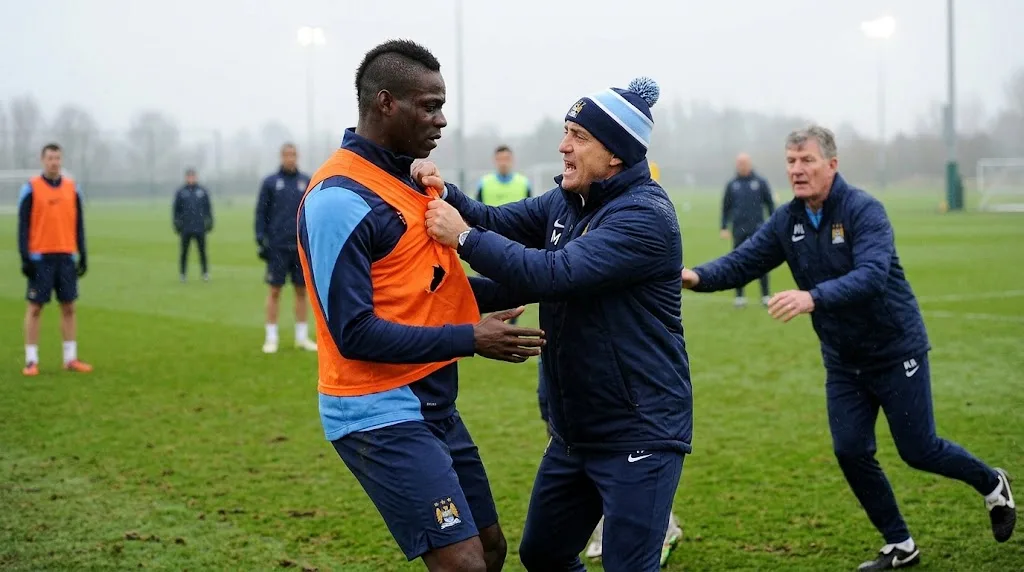
Roberto Mancini did not even wait to blow his whistle. He just sprinted. Across the freezing grass of Manchester City’s Carrington training ground, the manager charged straight at Mario Balotelli. Mancini was forty-eight years old, wearing a team jacket and a wool bobble hat. Balotelli was twenty-two, standing over six feet tall in a bright orange bib.
Before any player could react, Mancini reached out with both hands. He snatched the collar of Balotelli’s bib, yanked him forward, and tried to throw the striker to the turf.
Balotelli did not fall. He planted his boots into the mud, stiffened his neck, and stared down at his boss. Mancini’s face turned bright red. He pulled again, trying with all his strength to drag the young forward down.
Assistant coach Brian Kidd saw the madness and started running. He threw his arms around Mancini’s chest, dragging the shouting manager backward before punches could fly.
A heavy silence fell over the pitch. Nobody moved.
Just beyond the wire fences and tall hedges, long camera lenses clicked away. The secret was out before the players even reached the showers.
To understand why Mancini lost his mind that cold Thursday morning, you have to understand their history. Mancini was never just a regular manager to Balotelli. He was the closest thing the striker had to a football father.
Mancini gave Mario his professional debut at Inter Milan when the boy was only seventeen years old. He saw a rare, golden talent in the kid from Palermo. When Mancini took the Manchester City job, he made the club spend twenty-four million pounds to bring Mario to England.
From the day Balotelli landed in Manchester, chaos followed him everywhere.
He threw darts at youth team players from a first-floor window because he was bored. He set his own bathroom on fire after shooting off fireworks inside the house. He crashed his expensive sports car with five thousand pounds in cash sitting on the passenger seat. When police asked why he had so much money, Mario simply replied, “Because I am rich.”
Through every scandal, Mancini protected him.
The British press attacked Balotelli every single week. Pundits called him a clown and a waste of money. Yet Mancini stood in front of the microphones and defended him like family.
“I love Mario,” Mancini once told reporters. “He is a good boy. He makes mistakes, but he has a big heart.”
The loyalty seemed worth it in May 2012. In the final seconds of the season, Balotelli slipped a sliding pass through to Sergio Agüero to score the most famous goal in Premier League history. That single moment brought Manchester City their first league title in forty-four years.
Mancini had stood by his prodigal son, and his son had delivered the crown.
By January 2013, however, the magic was wearing thin. City were trailing Manchester United in the title race, and Mancini was feeling the pressure. Balotelli was showing up late, playing poorly, and fighting with club staff.
Still, nobody expected what happened on January 3.
The squad was playing a simple eleven-a-side practice game ahead of an FA Cup match against Watford. It was a routine drill with nothing at stake.
Winger Scott Sinclair received the ball out wide. Out of nowhere, Balotelli charged in and launched into a reckless, sliding tackle. His studs flew directly at his own teammate’s legs.
Sinclair jumped out of the way just in time, rolling on the grass in pain.
Mancini stood on the touchline, watching his star striker almost break the leg of a fellow City player in an easy practice drill. A wire snapped inside the manager’s brain.
Mancini halted the game and screamed at Balotelli to leave the pitch immediately. He told him to go inside the dressing room.
Mario refused. He looked his manager in the eye, mumbled an insult, and turned his back.
That was the moment Mancini lost control.
The Italian manager ran behind Balotelli, grabbed the neck of his training bib, and tried to trip him. Balotelli pushed back, swatting at Mancini’s arms. Mancini lunged again, pulling the fabric so hard it stretched out of shape.
“Get off the pitch!” Mancini yelled.
Kidd sprinted across the grass and wedged his body between the two men. He pushed Mancini back toward the bench while a club security guard walked over to lead Balotelli toward the building. Mario pulled off his torn bib, threw it onto the grass, and walked off without looking back.
The next morning, the pictures covered the front page of nearly every newspaper in Europe.
The images looked unreal. Here was a suave, championship-winning manager wrestling his own player like two schoolboys in a playground scrap.
Mancini had to face the media on Friday afternoon. He tried his best to laugh it off.
“It was nothing special,” Mancini told the room of reporters. “I played a match and Mario kicked his teammate. I said to him, ‘Go inside, leave the pitch.’ He said no, and I took his shirt and pushed him off the pitch.”
Reporters pushed him harder. Did he lose his temper?
“Yes, for two seconds,” Mancini admitted with a small grin. “Because he wouldn’t leave.”
When asked if Mario would ever play for him again, Mancini smiled and said, “I will give him one hundred more chances if I think he can change.”
Mancini said the right words for the cameras. But behind closed doors, the truth was already settled.
The father had run out of forgiveness.
Less than four weeks after the Carrington fight, Manchester City sold Balotelli to AC Milan for nineteen million pounds. They took a loss on the fee just to get him out of the building. Mancini did not fight the board’s decision this time. He did not ask them to give his boy another chance.
Balotelli left Manchester with a Premier League medal and an FA Cup trophy. He also left behind a broken relationship with the only manager who truly believed in him.
Years later, Mancini admitted that his heart ached whenever he thought about Mario’s career. Balotelli had the raw talent to become one of the greatest strikers on earth, but his mind never caught up with his feet.
Managers can draw tactics on a whiteboard. They can teach a striker how to make a run or finish with his left foot. They can even defend a player when the whole world turns against him.
On that cold morning in Carrington, Roberto Mancini learned the most painful lesson in football management: you cannot save someone who refuses to save himself.

Callum Mercer is a football journalist and digital editor specializing in long-form features, human-interest narratives, and regulatory shifts across European and world football. With nearly a decade of experience tracking player journeys from lower-league academies to continental tournaments, Callum focuses on primary-source reporting, tactical context, and the untold stories behind the matchday headlines.