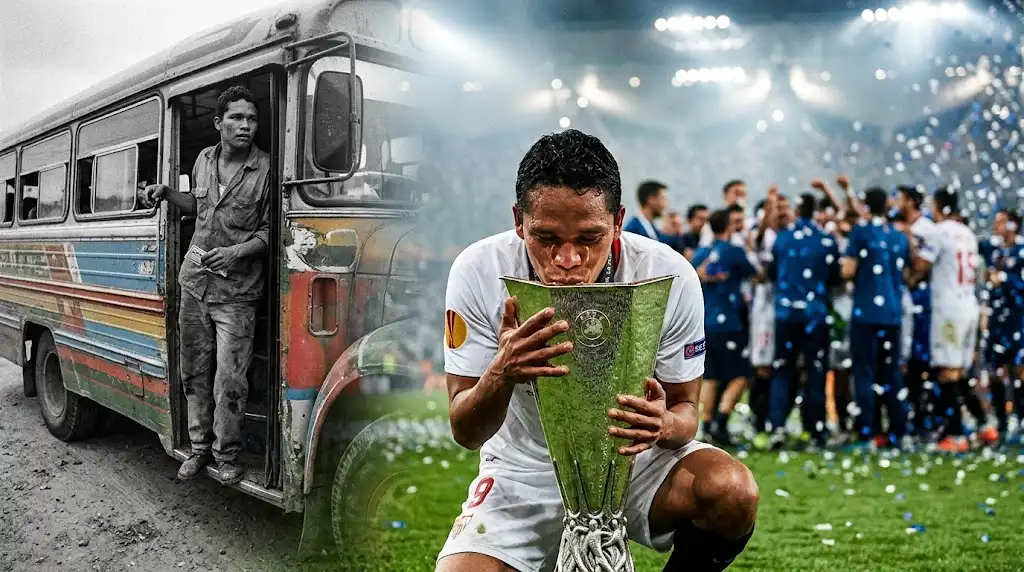
The noise inside the National Stadium in Warsaw was deafening. Seventy-three minutes were on the clock, and the 2015 Europa League final stood locked at 2-2. Sevilla needed a hero against a stubborn Dnipro side that refused to break.
A loose ball bounced toward the edge of the Ukrainian penalty box.
Carlos Bacca did not hesitate. He took one clean touch with his left boot to set himself, and then blasted a low strike past the goalkeeper into the corner of the net.
The net rippled. The Sevilla bench erupted into pure chaos.
Bacca sprinted toward the corner flag, dropped hard onto his knees, and pointed both index fingers straight up at the sky. He was the undisputed king of European football’s second-biggest prize.
Nine years earlier, nobody in world football knew his name.
Nine years earlier, Carlos Bacca was not dreaming about shiny trophies in Europe. He was just trying to earn enough money to eat.
In 2006, Bacca lived in Puerto Colombia, a small coastal town near the Caribbean port city of Barranquilla. Life was rough, and money was always tight.
His family often stared at empty dinner plates, wondering where their next meal would come from.
Today, elite football clubs pay fifty million euros for teenagers who have never played a single minute of first-team football. At age twenty, Bacca did not even have an agent.
He was completely off the radar of every professional scout on the planet.
His alarm clock went off at four in the morning. The air in his small room was always thick and sticky with tropical humidity.
Before the sun rose over the ocean, Bacca was already down at the shore pulling heavy fishing nets out of the Atlantic water.
Fishing paid very little, but every single peso mattered. Once the morning catch was sorted, he wiped the fish scales off his skin and hurried to his second job.

That job was not glamorous either. Bacca climbed aboard a battered passenger bus that ran the rough route between Puerto Colombia and Barranquilla.
He was not behind the wheel. He worked as the bus driver’s assistant, collecting fares from passengers.
His station was the open doorway of a rattling vehicle with no air conditioning. Bacca spent fourteen hours a day hanging on to the metal bars in the blistering heat.
He shouted destinations to people standing on street corners and pushed through crowded aisles to collect coins.
At the end of every shift, his hands smelled like stale diesel fuel, dirty copper coins, and sweat. The bus bounced over pothole-covered roads until his back throbbed with pain.
He earned barely enough money to keep his family afloat.
Professional football felt like a fantasy made for other people. Bacca was already in his twenties, an age when most young players with no contract hang up their boots for good.
Yet, deep down, he refused to let go of the ball.
Whenever his exhausting shifts on the bus ended, Bacca ran straight toward the sand.
On Sunday afternoons, he played in local neighborhood tournaments along the coast. The pitches were uneven and dusty, and the tackles were bone-crunching.
Bacca did not care about the bruises. With the ball at his feet, he was untouchable.
He blew past older defenders with sudden bursts of speed and struck the ball with terrifying power.
Whispers about the kid on the beach began spreading across town. Locals told youth coaches that a transit worker in Puerto Colombia was scoring goals for fun on the sand.
Eventually, a scout from Junior de Barranquilla came down to watch him play.
Junior was the biggest club on the northern coast of Colombia. They loved his raw pace and eye for goal, but there was a huge problem: they only offered him an unpaid trial.

Taking the offer meant giving up his daily earnings on the bus. It was a massive financial gamble for his struggling family, but Bacca took the leap anyway.
He trained like a man possessed, running until his chest burned.
Junior signed him to a small contract, but they did not drop him into the first team right away. Instead, they sent him out on loan to learn the hard realities of professional football.
His first stop was Minervén in the tough second division of Venezuela. Bacca scored twelve goals in twenty-nine games and fired them to promotion.
Junior then sent him on loan to Barranquilla FC in Colombia’s second tier. He finished that season as the league’s top scorer with fourteen goals.
By 2009, the Junior coaching staff could no longer keep him on the fringes. Bacca was twenty-two when he finally made his first-division debut against Deportivo Pasto.
He started the match on the bench. In the second half, his manager told him to warm up and get on the pitch.
Bacca sprinted onto the turf hungry and fearless. Within forty-five minutes of game time, he scored two goals to win the match.
The stadium went wild. The bus conductor had officially arrived.
Over the next three seasons, Bacca scored seventy-three goals for Junior, won two Colombian league titles, and topped the scoring charts twice.
Europe was finally paying attention. In January 2012, Belgian side Club Brugge paid 1.5 million euros to bring him across the Atlantic Ocean.
Many South American attackers struggle with the freezing winters and tactical speed of European leagues. Bacca just kept scoring goals.
In his only full season in Belgium, he found the net twenty-five times in league play. He was named the best player in the entire Belgian league.
That caught the eye of Sevilla manager Unai Emery in Spain. Emery was building a hungry, aggressive team that pressed defenders all over the pitch.

Emery wanted a striker who ran like every match was his last meal on earth. He saw that hunger in Bacca, a forward who remembered what fourteen-hour bus shifts felt like.
Sevilla paid seven million euros for him in 2013. In his very first season in Spain, Bacca scored twenty-one goals across all competitions.
He stepped up during the 2014 Europa League final against Benfica, coolly burying his spot-kick during the penalty shootout to hand Sevilla the crown.
He was already a hero in Spain, but his biggest moment was waiting in Poland.
That brings the story back to Warsaw in May 2015.
Bacca did not just score the winning goal against Dnipro that night. He scored two goals, set up another, and walked off the pitch holding the official Man of the Match trophy.
When the final whistle blew to seal the 3-2 victory, Bacca did not immediately join the team dogpile. He grabbed a Colombian flag, draped it over his shoulders, and broke down in tears on live television.
“When I was twenty, all the doors were closed to me,” Bacca told reporters in the tunnel after the match. “Life was very hard. But God gave me an opportunity, and I never let it go.”
Two months after lifting that trophy in Warsaw, Italian giants AC Milan bought him for thirty million euros. He went on to score thirty-four goals in Serie A while wearing the famous red and black shirt.
Years later, he won yet another Europa League title with Villarreal in 2021, beating Manchester United in a historic penalty shootout.
Yet whenever Bacca returns home to Puerto Colombia, he does not walk around like an untouchable star. He walks down the exact same dusty streets where he used to work.
He visits the bus depot where he once collected fares, laughing and chatting with the drivers who remember him as a skinny teenager with torn shoes.
Bacca also built a charitable foundation in his hometown. He pays for youth football pitches, buys school supplies, and provides hot meals to kids growing up in poverty.
Modern football spends millions trying to build the perfect athlete inside expensive academies. Scouts look at computer data, body fat numbers, and sprint tests.
Carlos Bacca’s journey shows that true greatness cannot always be measured on a coach’s tablet.
Sometimes, the best striker on the continent is not training in a clean academy. Sometimes, he is just a hungry young man hanging out the door of a crowded bus, waiting for his stop.

Callum Mercer is a football journalist and digital editor specializing in long-form features, human-interest narratives, and regulatory shifts across European and world football. With nearly a decade of experience tracking player journeys from lower-league academies to continental tournaments, Callum focuses on primary-source reporting, tactical context, and the untold stories behind the matchday headlines.