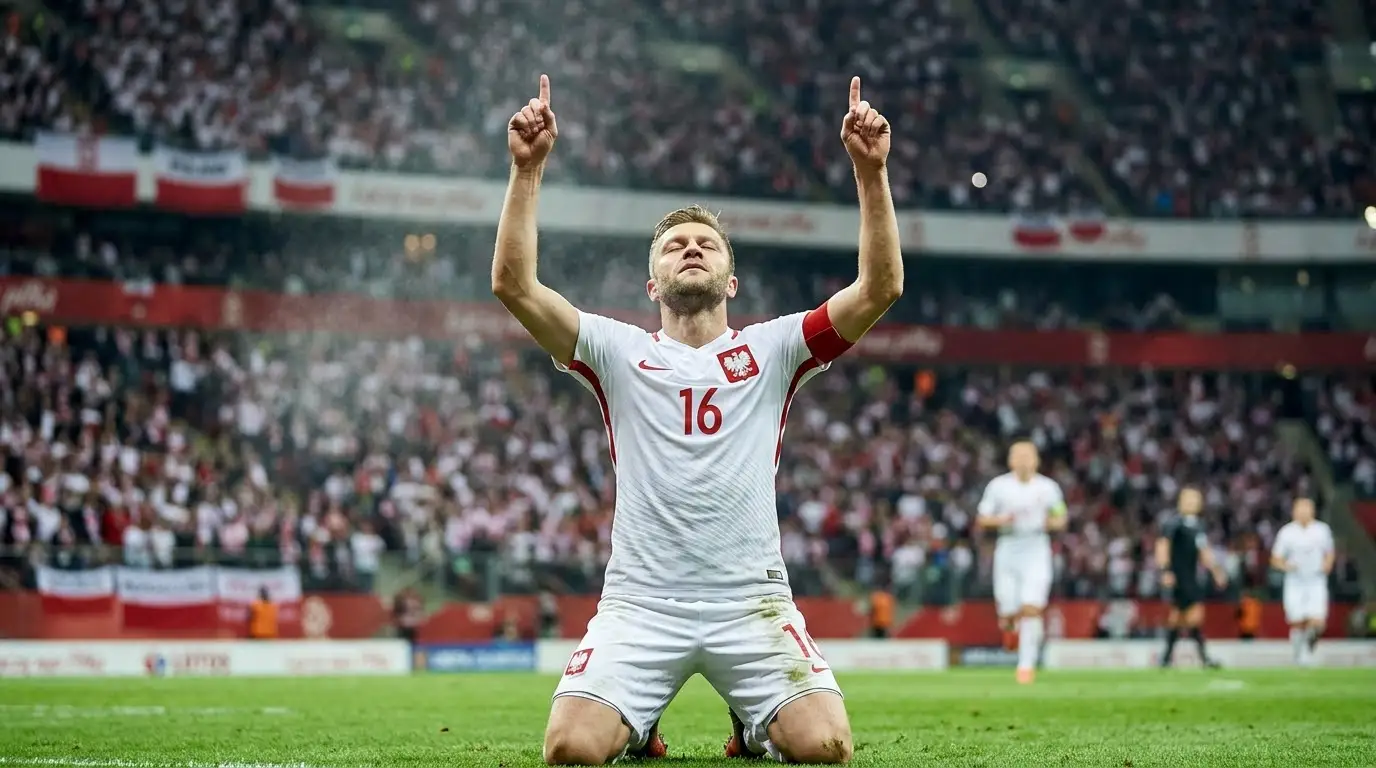
The 57th minute at the National Stadium in Warsaw was suffocating.
Poland were trailing Russia 1-0 in a Euro 2012 clash drenched in decades of geopolitical friction. Alan Dzagoev’s first-half header had silenced the capital, and the co-hosts were staring into the abyss.
Then the ball broke toward the right flank.
Jakub Błaszczykowski, wearing the captain’s armband, dropped his shoulder, sliced inside Russian defender Sergei Ignashevich onto his weaker left foot, and uncorked a thunderous 20-yard missile into the top corner.
Fifty-six thousand fans erupted in delirium. The concrete beneath Warsaw rattled.
Yet Kuba did not sprint to the corner flag to scream into a camera lens.
Instead, he dropped to his knees on the turf. He closed his eyes, tilted his head, and pointed both index fingers straight into the gray sky.
To the millions watching across the globe, it looked like routine football piety.
To the boy inside him, it was a message delivered across a boundary no stadium floodlight could ever reach.
To understand that gesture, you have to travel back sixteen years to September 1996, to the quiet village of Truskolasy in southern Poland.
Jakub was ten years old. He lived for two things: kicking a worn football across gravel pitches with his older brother Dawid, and the quiet warmth of his mother, Anna.
His father, Zygmunt, was a volatile presence battling severe alcoholism. Domestic shouting was a regular dread inside the home, but that autumn evening, the noise shattered into violence.
Jakub was playing with toys when his mother’s desperate cries pierced the wall.
He ran into the room. What he saw in that split second would define every sprint, every recovery run, and every tackle of his professional life.
Zygmunt had plunged a knife into Anna.
Ten-year-old Jakub rushed to her side on the floor, frantically trying to stop the bleeding with his small hands as her life slipped away.
Zygmunt was arrested and sentenced to 15 years in prison. Jakub’s universe folded into absolute darkness.
For days, the boy refused to get out of bed. He would not speak. He would not eat.
The boots he laced up for the local youth side Raków Częstochowa sat untouched in the corner. He swore he would never touch a football again.
Trauma did not just wound his mind; it stunted his physical growth.
At fifteen, while peers filled out their adult frames, Jakub stood barely 155 centimeters tall. Academy coaches across the country took one look at his frail frame and looked away. Górnik Zabrze dropped him after just a few months.
Stuck in the obscurity of Poland’s fourth division with KS Częstochowa, his dream looked dead.
Two people refused to let the darkness win: his grandmother Felicja, who raised Jakub and Dawid on a tiny pension, and his uncle, Jerzy Brzęczek.
Brzęczek was a giant of Polish football, having captained the national side to Olympic silver at Barcelona 1992. He understood you could not lecture a child out of post-traumatic shock.
So Brzęczek dragged him back to the pitch. He offered no hollow sympathy. He dropped a ball at the boy’s feet, pointed to the touchline, and demanded work.
And Kuba ran.
He ran with a manic, unrelenting hunger. On the grass, running wasn’t just tactical; it was his way of keeping the nightmares from catching him.
“I will never understand why it happened,” Błaszczykowski wrote years later in his autobiography, Kuba. “That day changed my life forever. But it also gave me great strength. I have had to deal with adversities that others would never be able to handle.”
In early 2005, Brzęczek secured him a trial at Wisła Kraków.
Manager Werner Lička watched the kid sprint across the half-spaces for twenty minutes before calling the front office. Within months, Kuba was an indispensable starter, helping Wisła claim the Polish top-flight crown.
The boy who had spent months lying motionless in bed was now the most relentless right winger in the country.
When Jürgen Klopp arrived at Borussia Dortmund in 2008 to build his full-throttle gegenpressing machine, Kuba became his foundational soldier.
He was not a winger who wasted breath on pointless stepovers. Kuba was an engine. He harried full-backs, covered seventy yards of grass on transitions, and whipped pinpoint deliveries to Robert Lewandowski.
Under Klopp, he won two Bundesliga titles, lifted the DFB-Pokal, and started the 2013 Champions League final at Wembley.
Yet the pain never truly left him.
In May 2012, just weeks before Euro 2012 began, his father died at age 56 following his release from prison.
Kuba had not spoken to Zygmunt for sixteen years. Still, alongside his brother Dawid, he traveled back to Truskolasy and quietly stood at the funeral. There were no cameras, no public declarations, and no drama. He simply buried the past and reported straight back to Poland’s training camp.
“My mother is looking after me,” Kuba stated after that thunderbolt against Russia. “I have had some difficulties in my life, but I am perfectly certain she is somewhere watching over me.”
His character shone even brighter in 2019. When his beloved Wisła Kraków faced financial collapse and extinction, Kuba stepped in to loan the club over 1 million złoty from his personal savings, signed a contract to play for the league minimum wage of roughly $130 a month, and donated every single paycheck to purchase tickets for local children.
He never played football for fame, branding, or money.
His career was forged on the quiet bedroom floor where a ten-year-old lost everything. Anna never saw him lead Poland out of the tunnel or lift trophies under the Dortmund lights. But every time the net billowed and the world chanted his name, Jakub Błaszczykowski pointed straight up to the sky—letting his mother know that her boy had made it through the storm.
For an intimate look at his path from small-town tragedy to European football heights, check out Jakub Błaszczykowski’s Incredible Journey.
This video documents the defining moments of Błaszczykowski’s life and career, capturing the personal resilience behind his legendary status on the pitch.

Callum Mercer is a football journalist and digital editor specializing in long-form features, human-interest narratives, and regulatory shifts across European and world football. With nearly a decade of experience tracking player journeys from lower-league academies to continental tournaments, Callum focuses on primary-source reporting, tactical context, and the untold stories behind the matchday headlines.