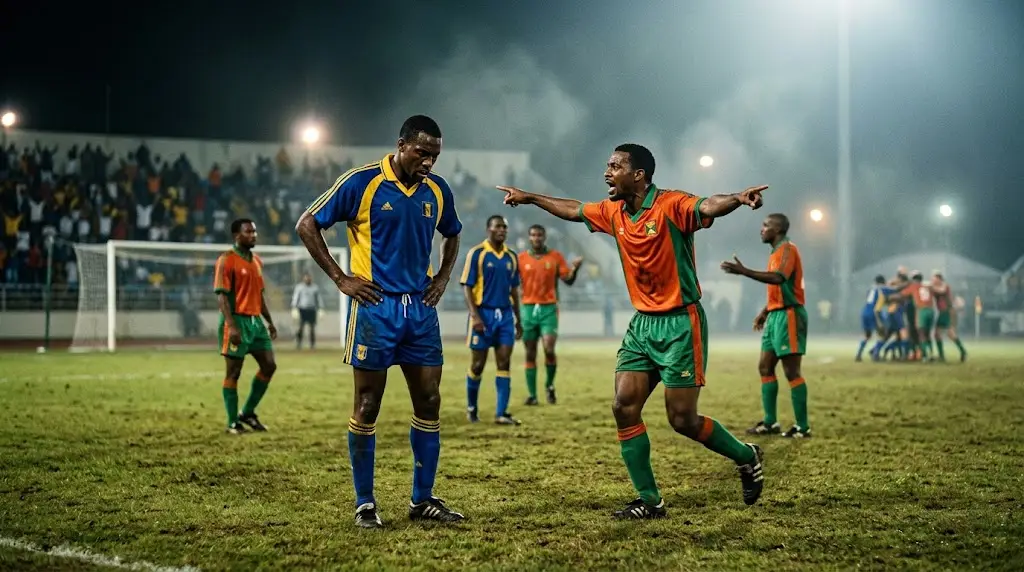
The clock at the Barbados National Stadium showed eighty-seven minutes.
Barbados led Grenada 2-1. On paper, they were winning the game, but on the pitch, elimination was staring them right in the face.
Barbadian defender Terry Sealey had the ball at his feet inside his own penalty box. He looked up at his goalkeeper, Horace Stoute.
There was no Grenada attacker pressing them. There was no loose ball bouncing dangerously near the six-yard box.
Sealey and Stoute calmly passed the ball back and forth to each other.
Then, Sealey did the unthinkable. He pulled back his right boot and hammered the ball straight into his own net.
The home crowd fell completely silent.
The scoreboard clicked over to 2-2.
Grenada’s players stood frozen in disbelief. Why had the winning team just scored an intentional own goal with only three minutes left on the clock?
The answer was not panic. It was cold, ruthless math.
To understand the chaos of January 27, 1994, you have to look at one of the strangest rulebooks ever written.
Barbados, Grenada, and Puerto Rico were competing in Group 1 for a single spot in the 1994 Caribbean Cup finals.
Earlier in the group, Puerto Rico had beaten Barbados 1-0, and Grenada had beaten Puerto Rico 2-0.
That left Grenada at the top of the standings with three points and a plus-two goal difference. Barbados sat at the bottom with zero points and a minus-one goal difference.
To qualify, Barbados did not just need a win. They had to beat Grenada by at least two clear goals.
Normally, a draw in a group game gives each team one point. But the tournament organizers had introduced an experimental rule for this edition.
Every single match had to produce a winner. If ninety minutes ended in a tie, the game went directly to sudden-death extra time.

The first team to score in extra time would win on a golden goal.
Here was the trap: organizers decided that any golden goal scored in extra time would count as two goals on the final scoresheet.
Nobody had stopped to think about what that rule would do to players under pressure.
For eighty minutes, Barbados executed their plan to perfection.
They built a 2-0 lead in front of their home fans in Saint Michael. As things stood, that two-goal cushion was exactly what they needed to punch their ticket to the finals.
Then came the eighty-third minute.
Grenada broke through and scored to make it 2-1.
Barbados was still winning the match, but that scoreline was useless to them. On goal difference, Grenada would still finish first and advance.
Barbados poured forward to find a third goal.
For four minutes, they crossed balls into the penalty box, but Grenada parked ten men behind the ball. Every clearance flew out into the stands.
With the eighty-seventh minute approaching, Barbados realized they were running out of time.
That was when Terry Sealey and Horace Stoute figured out the loophole.
Scoring against ten packed defenders in three minutes was nearly impossible. But scoring an own goal was easy.
If Barbados tied the game 2-2, normal time would end in a draw. That would force thirty minutes of extra time.
Under the double golden goal rule, just one goal in extra time would count as two. That would instantly make the final score 4-2, handing Barbados the exact two-goal margin they needed.
Sealey turned around and drove the ball past Stoute. The game was tied 2-2.
For a brief moment, Grenada celebrated the free goal. Then, the reality of the math hit their sideline.
Grenada realized they were in mortal danger. If the game went to sudden-death extra time, one Barbadian shot would knock them out.
To advance right then, Grenada simply needed the match to end without going to extra time. They only had to avoid losing by two goals.
If Grenada scored in the Barbados net, they would win 3-2 and qualify.
Even wilder: if Grenada scored an own goal in their own net, Barbados would win 3-2. A 3-2 loss was only a one-goal margin, meaning Grenada would still win the group on goal difference.
Grenada did not care which net they scored in. Any goal at either end of the field would send them to the tournament.
The final minutes exploded into pure madness.
Grenada attacked both nets at once. Half their team charged toward the Barbados goal, while the other half sprinted backward to try to kick the ball into their own net.
Barbados had to react instantly.
They split their team in two. Half of the Barbados players defended their own net, while the other half ran across the pitch to protect Grenada’s goal.
Barbadian forwards were throwing themselves into sliding tackles inside Grenada’s penalty area to stop Grenada from scoring an own goal.
For three minutes of stoppage time, Barbados somehow defended both ends of the pitch until the referee blew the whistle for full-time.
The gamble paid off. The match went to extra time locked at 2-2.
Grenada’s players were mentally drained before the extra period even kicked off.
Four minutes into extra time, Barbados striker Trevor Thorne broke into space and drilled a shot past the Grenada goalkeeper.
The golden goal hit the net.
Because of the special rule, Thorne’s single strike counted for two goals. The official score stood at Barbados 4, Grenada 2.
Barbados had pulled off the most outrageous tactical plan in international football history. They were going to the finals.
After the final whistle, Grenada manager James Clarkson made no effort to hide his fury.
“I feel cheated,” Clarkson told reporters after the match. “The person who came up with these rules must be a candidate for a madhouse.
“The game should never be played with so many players running around the field confused. Our players did not even know which direction to attack: our goal or their goal. I have never seen this happen before. In football, you are supposed to score against the opponents to win, not for them.”
FIFA reviewed the match report and determined Barbados had broken no laws. They had simply solved the mathematical puzzle created by the organizers.
Tournament officials quickly realized the danger of the experiment. The double golden goal rule was scrapped immediately after the 1994 Caribbean Cup and never used again.
Football has seen plenty of weird moments, but that night in Saint Michael stands completely alone. It remains the only match where a team had to score on themselves to survive, and then defend both nets to win.

Callum Mercer is a football journalist and digital editor specializing in long-form features, human-interest narratives, and regulatory shifts across European and world football. With nearly a decade of experience tracking player journeys from lower-league academies to continental tournaments, Callum focuses on primary-source reporting, tactical context, and the untold stories behind the matchday headlines.