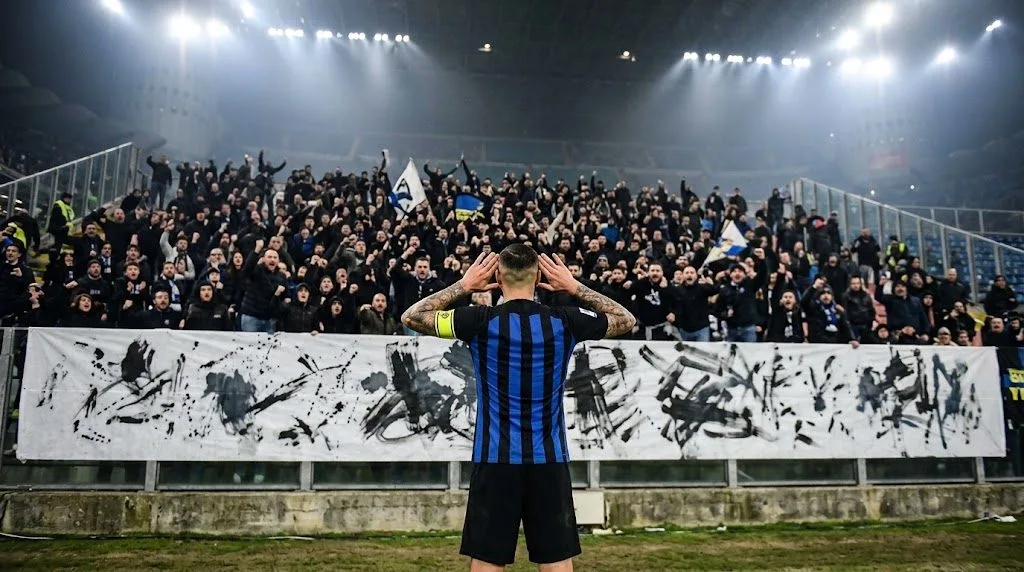
Mauro Icardi stood over the penalty spot at San Siro, thirty-three thousand eyes boring into the back of his neck.
It was the twenty-sixth minute against Cagliari on October 16, 2016. In normal times, the stadium’s north stand—the famed Curva Nord—would be a vibrating cathedral of noise, chanting their twenty-three-year-old captain’s name.
Instead, a chilling silence hung over the concrete tier. Suspended from the railings was a massive, forty-foot banner dripping with contempt: “You use a child to justify yourself and fling mud in our faces… You are not a man. You are not a captain. You are just a vile piece of shit.”
Icardi took a measured, three-step run-up. He struck the ball cleanly, but sent it bouncing harmlessly wide of Marco Storari’s right-hand post.
Then came the sound that tore the fabric of Italian football: the Curva Nord erupted into wild, rapturous celebration.
Inter Milan’s most militant supporters were not mourning a missed spot-kick. They were actively cheering against their own top scorer, their talisman, and the man wearing the captain’s armband.
The Shirt Toss in Reggio Emilia
To understand why thousands of match-going ultras celebrated their own team’s misfortune, you have to rewind twenty months to a freezing Sunday afternoon in Reggio Emilia.
On February 1, 2015, Roberto Mancini’s struggling Inter had just been comprehensively dismantled 3–1 by Sassuolo at the Mapei Stadium.
Desperate to show accountability to the traveling support, Icardi and Colombian midfielder Fredy Guarín walked across the wet turf to face the away enclosure. The fans were furious, spitting insults through the perimeter fences.
Icardi unpeeled his match jersey, soaked in sweat and cold rain, and tossed it gently over the barrier into the hands of a small boy standing at the front.
What happened next became Italian football folklore. Before the child could celebrate, an ultra leader stepped in, ripped the shirt violently from the boy’s grasp, and hurled it back onto the pitch with pure disgust.

Icardi snapped. He unleashed a barrage of furious Spanish and Italian expletives directly at the ultras, his face twisted in rage before Guarín physically dragged him away toward the tunnel.
In the hyper-political ecosystem of Italian fan culture, this was high treason. The unspoken code of il calcio dictates that when the Curva demands submission after a defeat, players lower their heads, absorb the insults, and walk away.
Mauro Icardi had not bowed. Worse still, he decided to immortalize his defiance in print.
“I Will Bring 100 Criminals From Argentina”
In October 2016, Italian publishing house Mondadori released Icardi’s autobiography, Sempre Avanti (“Always Forward”).
Publishing a memoir at twenty-three was already an exercise in staggering vanity, but page 134 contained pure radioactive waste. Recounting the clash in Reggio Emilia, Icardi wrote that he returned to the locker room as an undisputed hero among his teammates.
He then detailed a confrontation with Inter’s sporting management, who were terrified that militant fans would arrive at the Appiano Gentile training complex to physically attack him.
According to his own published words, Icardi looked the executives in the eye and delivered an ultimatum fit for a cartel boss:
“I am ready to face them one by one. How many are there? Fifty, a hundred, two hundred? OK, record my message and let them hear it: I will bring 100 criminals from Argentina who will kill them on the spot, then we’ll see.”
When copies hit the shelves in Milan, the reaction was instantaneous. The Curva Nord felt public death threats from their own captain could not go unanswered.
On the morning of the Cagliari game, the ultra leadership published an incendiary open letter declaring Icardi finished at Inter. They claimed his entire story was an invented fiction to make himself look like a tough guy, asserting that the boy with the shirt never existed and that Icardi had simply tossed the shirt into the crowd out of pure arrogance.
“A twenty-three-year-old cannot behave like this,” the statement read. “He writes about hiring hitmen to murder his own supporters. For us, he is no longer our captain.”
The Ambush Outside the Gates
Missing the penalty against Cagliari was only the beginning of a terrifying Sunday for the Argentine striker.
When Icardi drove his luxury SUV home to his high-rise apartment block in Milan’s San Siro district that evening, the reality of what he had written caught up with him.
Waiting in the shadows outside his residence were approximately forty hooded ultras. As Icardi’s vehicle approached the entrance gates, they attempted to block his passage, pounding on the windows before unfurling another banner outside his front door:
“We are here. When will your Argentine friends arrive?”
Armed private security had to intervene to escort Icardi, his wife and agent Wanda Nara, and their children safely inside the building. The bravado typed onto glossy pages had manifested as a direct, physical threat on his doorstep.
The following morning at Appiano Gentile, there was no institutional protection. Javier Zanetti, Inter’s legendary former captain and current vice-president—a revered compatriot who had won sixteen trophies with the club—addressed the media without a shred of sympathy for Icardi.
“We cannot accept this kind of behavior from an employee of this club,” Zanetti stated coldly. “The fans are the most important element. They accompany us, and everyone must respect them.”
Inter immediately fined Icardi the maximum allowable percentage of his monthly wage and forced him to pull every unsold copy of Sempre Avanti from bookstores worldwide. A revised edition was rushed to print, completely scrubbing the paragraph about Argentine hitmen and the Reggio Emilia incident.
Icardi issued a formal apology on social media, admitting he had “used exaggerated tones” and promised to remove the offending pages.
He kept the captain’s armband for two more years, but the relationship was irreversibly charred. The Curva Nord never chanted his name again, turning their backs during team announcements and treating every goal he scored with sullen indifference.
When Wanda Nara’s public contract posturing finally blew up the dressing room in 2019, manager Luciano Spalletti stripped Icardi of the captaincy without any pushback from the terrace.
In modern football, supporters will forgive missed penalties, poor form, and even flirtations with rival clubs.
What they will never forgive is a captain who looks across the barricade and threatens to send a hit squad into their home.

Callum Mercer is a football journalist and digital editor specializing in long-form features, human-interest narratives, and regulatory shifts across European and world football. With nearly a decade of experience tracking player journeys from lower-league academies to continental tournaments, Callum focuses on primary-source reporting, tactical context, and the untold stories behind the matchday headlines.