
The clock in the Santiago Bernabéu ticks into the 88th minute of a suffocating Champions League knockout tie, and two blue shirts are sprinting at Eduardo Camavinga’s throat.
He receives the ball on the half-turn, locked inside his own defensive third with nowhere to hide. Eighty thousand Spaniards hold their breath as the opposition press arrives with violent intent, looking to force the fatal mistake.
Camavinga does not flinch.
He drops his left shoulder, drags the ball backward with the sole of his boot, and spins into daylight with the easy grace of a teenager playing cage football on a Sunday afternoon. The press evaporates into thin air.
Pundits call it tactical maturity. Commentators rave about his press-resistance and effortless spatial awareness.
They think his composure is a product of elite academy drills and top-tier tactical coaching.
They are wrong.
You cannot intimidate a young man with a stadium whistle when his definition of real fear was settled on a cold French pavement when he was barely 11 years old.
To understand why Camavinga plays football like a man who feels no pressure, you have to trace the bloodlines back long before he ever wore the white of Real Madrid or the red of Stade Rennais.
He was born in 2002 inside Miconje, an overcrowded refugee camp in Cabinda, Angola. His parents, Celestino and Sofia, had fled the armed conflicts tearing through the Democratic Republic of the Congo, clutching their infant son and praying for a future that did not smell of gunpowder.
When Eduardo was just two, the family secured passage to France, first enduring the freezing grey streets of Lille before eventually settling in Fougères, a quiet commune tucked into Brittany.
Life there was an everyday grind. Celestino worked punishing shifts in slaughterhouses and on construction sites, while Sofia cleaned hotel rooms until her hands blistered.
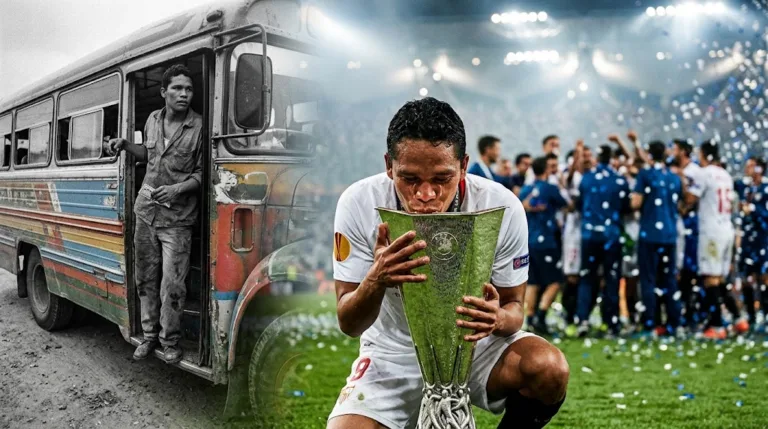
Every single euro was accounted for, hoarded with quiet discipline. By 2012, after nearly a decade of saving scraps, the Camavinga family finally achieved the immigrant dream: they bought their own modest family house.
Eduardo was already turning heads at local club Drapeau-Fougères. He was skinny, quick-witted, and played with an infectious grin, quickly catching the attention of Rennes’ regional scouts.
For the first time in their lives, the family had four solid walls, a plot of land, and legal roots. They believed they were finally safe.
Then came a spring afternoon in 2013.
Eduardo was walking home from school, expecting the familiar smell of his mother’s cooking. Instead, as he turned the corner into his neighborhood, thick black smoke was choking the Brittany sky.
Fire trucks lined the curb, their sirens screaming into the quiet afternoon.
Eduardo pushed through the gathering crowd of neighbors and froze. His family home was completely engulfed in an inferno.
Within hours, the roof collapsed into a smoldering graveyard of burnt timber, melted appliances, and ash. Everything was gone.
The family lost their clothes, their furniture, and the hard-earned savings hidden inside. Crucially, the fire also incinerated their legal residency papers and civil documents—the fragile paperwork that proved their right to exist in the country they now called home.
Standing on the asphalt, watching his mother weep as the firemen doused the embers, 11-year-old Eduardo broke down. He sobbed uncontrollably into his sleeves, terrified that the life his parents had bled to build had just vanished forever.
That was when Celestino walked over.
The father was exhausted, covered in soot, and staring at total financial ruin. Yet he did not raise his voice, and he did not despair. He placed a heavy, reassuring hand on his son’s shaking shoulder.
“Don’t cry,” Celestino told the boy, looking directly into his tear-streaked eyes. “You are the hope of this family, and you will rebuild this house through football.”
Most children at 11 carry the weight of homework and schoolyard rivalries. Eduardo Camavinga walked away from that curb carrying the survival of six people on his shoulders.
The next morning, with no clothes left except the spare tracksuits donated by neighbors and the local mayor’s office, Camavinga showed up to training.
His coach at Rennes noticed a shift. The joyful, goofy kid was still there, but an iron spine had formed beneath the surface. Football was no longer a hobby; it was a rescue mission.
His progression was frighteningly rapid. Rennes coaches watched him dominate older age groups not through brute force, but through an eerie, unflappable calmness in the middle of chaos.
In April 2019, at just 16 years, four months, and 27 days, Camavinga became the youngest first-team debutant in Rennes history. Four months later, Paris Saint-Germain came to Roazhon Park.
Facing a world-class midfield featuring Marco Verratti and Marquinhos, the 16-year-old put on a clinic. He dominated the central duel, floated an exquisite cross for the winning goal, and took home the Man of the Match trophy.
Europe’s scouting departments scrambled. Two years later, on transfer deadline day in August 2021, Real Madrid parted with €31 million to bring the teenager to the Spanish capital.
When Camavinga arrived at Valdebebas, he did not run out to buy supercars or diamond-encrusted jewelry.
His first major wire transfer went straight back to France. Eight years after watching his family home burn to the ground, Eduardo handed his parents the keys to a newly purchased, sprawling estate.
The promise made on the pavement of Fougères had been kept in full.
Today, when managers try to devise tactical schemes to rattle Camavinga—closing his passing angles, snapping at his ankles, or sending double-teams into his half-space—it rarely works.
How could it?
Modern football often confuses pressure with stakes. Playing in front of television cameras with a trophy on the line is a privilege.

True pressure is being 11 years old, standing in the cold, staring at the charred ashes of everything your parents ever worked for, and being told the only way out is through your boots.
Once you have survived that, ninety minutes in a football stadium is just a game.

Callum Mercer is a football journalist and digital editor specializing in long-form features, human-interest narratives, and regulatory shifts across European and world football. With nearly a decade of experience tracking player journeys from lower-league academies to continental tournaments, Callum focuses on primary-source reporting, tactical context, and the untold stories behind the matchday headlines.