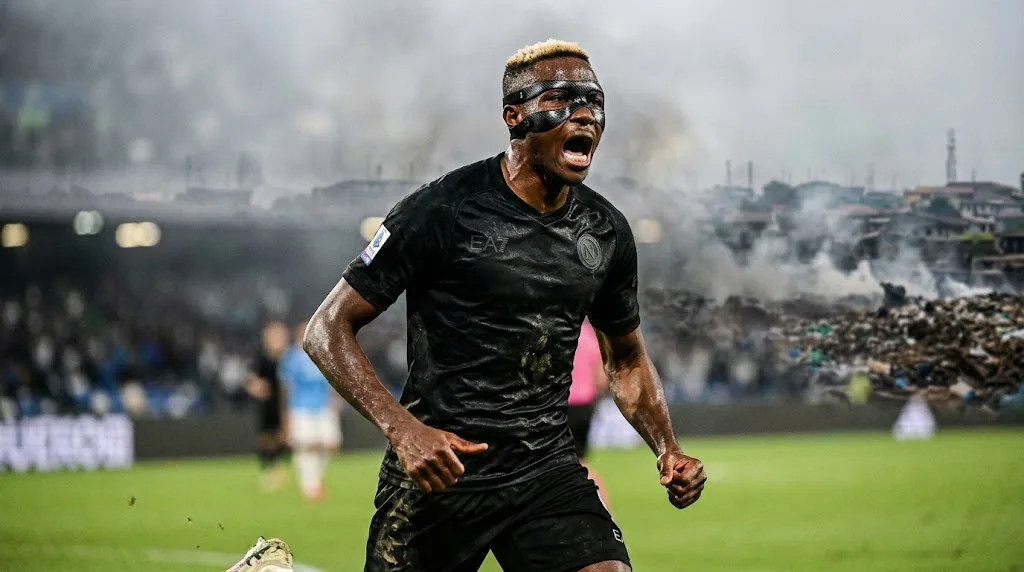
A tired center-back rolls the ball across the penalty box in the eighty-ninth minute. He thinks he has plenty of time to clear his lines, but Victor Osimhen is already flying across the grass at full speed. The Nigerian striker throws his whole body into the sliding challenge, blocking the ball and forcing a frantic turnover.
European commentators often praise this relentless energy as modern pressing for Napoli and Galatasaray. They talk about his intense work rate as if it were drawn up on a tactics board. In reality, that savage drive comes from somewhere much harder than any training ground.
Before he ever heard thousands of fans shouting his name in Europe, Osimhen was running for his life in Ojota. The heavy Lagos heat baked the asphalt as noisy yellow buses honked at packed intersections. A young Osimhen darted between moving cars, balancing a plastic tray of cold sachet water on his head.
Every single coin decided whether his family would eat that night. If he could not reach a driver before the red light turned green, supper was lost. He had to sprint past hot exhaust pipes and angry drivers, risking his life for pocket money.
The pressure grew even heavier when sudden tragedy hit their small home. His mother passed away when he was only a child, leaving the family heartbroken. In the very same week, his father lost his job.
With no money left and the rent collector knocking, the family had to fight for every meal. There was no time to cry or rest. Every brother and sister had to find a daily hustle on the street.
His brother sold morning newspapers, while his sister sold bags of oranges near the bus stops. Victor took on the dirtiest odd jobs across the neighborhood to scrape together a few coins. He spent long afternoons clearing out clogged gutters filled with green slime for twenty naira.

Much like the story of Carlos Bacca collecting bus fares in Colombia before finding European glory, young Osimhen knew honest labor had no room for shame. He carried heavy buckets of water for neighbors who could not fetch it themselves. Every hard job toughened his mind for the battles waiting on the pitch.
His daily grind mirrored the harsh reality of Steven Pienaar dodging gang violence in Westbury just to kick a ball. For Osimhen, football was the only real escape from the crushing weight of poverty. When he had a ball at his feet, hunger and worry disappeared.
Yet playing the game around Ojota brought another tough obstacle. Proper football boots were an impossible luxury that his family could never afford. If Victor wanted to play with real boots, he had to search for them in the neighborhood trash.
Rising right behind his community sat the Olusosun landfill, a giant hundred-acre mountain of smoking garbage. It was one of the largest open waste dumps in Africa, filling the air with foul smoke and burning fumes. While others saw disease and filth, local boys saw a hunting ground for football gear.
Every weekend, Osimhen and his friends climbed the burning trash heaps. They dug through piles of broken bottles and rusty iron, searching for discarded shoes. Finding an intact, matching pair was nearly impossible in the waste.
“Sometimes you found yourself with a Nike on the right foot, and then you start looking for the other foot, and finally you find a Reebok,” Osimhen told France Football years later. He did not care about the mismatched logos or funny colors. He tied the boots together with string and sprinted out onto the red dirt fields.
The mismatched boots never slowed his lightning speed. Osimhen outpaced and outmuscled boys who were much older and bigger than him. Coaches at Ultimate Strikers Academy soon noticed the boy who attacked loose balls with terrifying hunger.

National scouts quickly came calling, bringing him into Nigeria’s squad for the 2015 Under-17 World Cup in Chile. On the global stage, he tore through world defenses and won the Golden Boot with a record ten goals. Almost overnight, top clubs across Europe rushed to sign the teenage sensation.
The jump to Europe brought its own harsh tests, from heavy injuries in Germany to lonely months on the bench. Yet whenever doubt entered his mind, Osimhen remembered the Olusosun trash heaps. A boy who cleaned dirty gutters for small coins was not about to crumble under football pressure.
He battled his way through Belgium and France before leading Napoli to a historic Serie A title. In 2021, a terrible clash of heads shattered his cheekbone, requiring eighteen screws and six titanium plates. Instead of backing away, he strapped on a black protective mask and returned more aggressive than ever.
That masked face soon became a symbol of raw willpower, firing Napoli to their first league title in thirty-three years and earning Osimhen the African Footballer of the Year award. Fans worldwide bought replicas of his mask, viewing him as a superhero. Through every triumph in Italy and Istanbul, his feet have stayed firmly rooted in Lagos.
When you watch Osimhen sprint after hopeless balls today, you are seeing a survival instinct you cannot teach. He presses defenders with the wild urgency of a boy dodging cars in Ojota gridlock. That raw energy is not tactical science; it is the fight of someone who remembers the pain of an empty stomach.
Defenders facing Victor Osimhen are not just marking an elite forward. They are trying to stop a boy who dug through broken glass to find a boot that fit. That boy promised himself he would never go hungry again, and he plays every second to protect that promise.

Callum Mercer is a football journalist and digital editor specializing in long-form features, human-interest narratives, and regulatory shifts across European and world football. With nearly a decade of experience tracking player journeys from lower-league academies to continental tournaments, Callum focuses on primary-source reporting, tactical context, and the untold stories behind the matchday headlines.